
The debate between native and hybrid mobile app development reached a decisive turning point in 2025 — and in 2026, that shift is irreversible. With 72% of new mobile apps now built using hybrid or cross-platform frameworks, and with Flutter 4 and React Native 0.75 delivering near-native performance across iOS and Android, the case for building two separate native apps has largely collapsed for most business use cases.
For companies working with a mobile app development company, this shift represents a massive opportunity: reach both iOS and Android users with a single codebase, at 40–60% lower cost, in roughly half the time. This guide covers everything you need to know about hybrid app development in 2026 — what it is, why it works, which frameworks to choose, and how to select the right development partner.
What Is a Hybrid App?
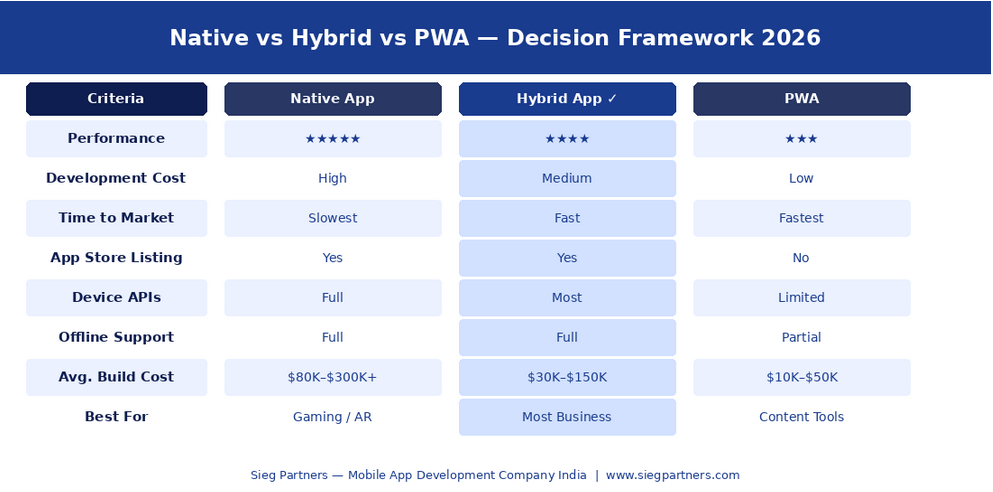
A hybrid app is a mobile application built using web technologies or cross-platform frameworks and packaged inside a native container that can be submitted to the App Store and Google Play. It has access to device hardware — camera, GPS, biometrics, push notifications — while sharing a single codebase across iOS and Android.
This is different from a Progressive Web App (PWA), which runs in the browser without an app store listing, and different from a native app, which is written separately in Swift (iOS) and Kotlin (Android). Hybrid apps sit in the middle: app store presence and device API access like native, with the cost and speed advantages of a single shared codebase.
The Core Benefits of Hybrid App Development
The advantages of hybrid development in 2026 are not marginal — they are structural. Here is what the data shows:
- – Cost savings of 40–60%: Building one codebase instead of two separate native apps cuts development cost significantly. For a mid-market app that would cost $120,000 native, a hybrid approach typically delivers the same functionality for $60,000–$80,000.
- – 2x faster time-to-market: A single development team working on one codebase ships faster than two parallel native teams. Most MVP-level hybrid apps launch in 8–12 weeks with a quality mobile app development company, versus 20+ weeks for native.
- – Easier updates and maintenance: With hybrid, a bug fix or new feature is deployed once and reflected across both iOS and Android simultaneously. No more dual release cycles, dual code reviews, or dual App Store submissions.
- – Access to most device APIs: In 2026, Flutter and React Native provide access to 95%+ of device hardware capabilities. Camera, GPS, biometrics, NFC, Bluetooth, push notifications — all available without native code in most cases.
- – Seamless AI integration: As an AI app development company, Sieg Partners has found that integrating LLM features, computer vision, and ML models is actually easier in hybrid apps than native — web APIs are faster to connect and update than compiled native code.
- – Larger developer talent pool: Flutter (Dart) and React Native (JavaScript/TypeScript) developers are significantly more available than iOS Swift or Android Kotlin specialists. This drives 20–30% lower hiring costs for product teams building in-house.
The 5% of use cases where native still wins: games requiring maximum GPU performance, augmented reality applications, apps that need access to the deepest OS-level APIs, and applications where sub-millisecond UI response is a hard requirement. For everything else — hybrid wins.
Top Hybrid App Development Frameworks in 2026
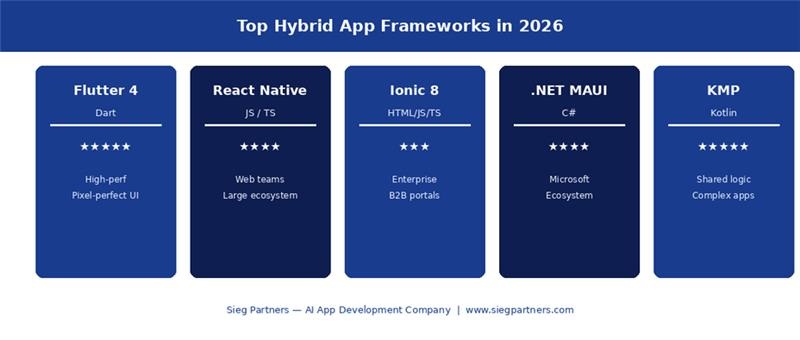
Choosing the right framework is the most critical technical decision in any hybrid app project. The wrong choice can haunt a product for years. Here is an honest assessment of the leading options in 2026:
Flutter 4.0
Flutter remains the top recommendation from Sieg Partners for most new greenfield projects in 2026. Its custom rendering engine (Impeller, now mature and production-ready) means Flutter does not rely on native UI components — it draws every pixel itself. The result is pixel-perfect, consistent UI across iOS, Android, and web from a single Dart codebase. Performance is genuinely excellent: Flutter apps regularly achieve 120fps on supported hardware. The main consideration is Dart, a language most developers will need to learn — though it is regarded as one of the easiest languages to pick up.
React Native 0.75
React Native is the right choice when your team has strong JavaScript or TypeScript experience, or when you are extending an existing web product into mobile. The New Architecture (JSI, Fabric, TurboModules) — fully stable since 2024 — has addressed most of the performance concerns that dogged React Native in earlier versions. The ecosystem is vast, the community is enormous, and the ability to share code with a React web application makes React Native particularly compelling for companies building across web and mobile simultaneously.
Ionic 8 with Capacitor
Ionic targets web developers who need to ship a mobile app without learning a new framework. It wraps standard HTML, CSS, and JavaScript inside a native shell via Capacitor. Performance has improved dramatically since Cordova was retired, but Ionic still lags behind Flutter and React Native for animation-heavy or media-rich applications. It is at its best for enterprise B2B tools, internal portals, and form-heavy workflow applications where raw UI performance is less critical than development speed.
.NET MAUI 9
Microsoft’s Multi-platform App UI is the right choice for organisations deep in the .NET/C# ecosystem. It delivers genuinely excellent performance and shares code across iOS, Android, macOS, and Windows — a combination no other framework matches. If your backend is already in C# and your team is .NET-fluent, MAUI deserves serious consideration in 2026.
Kotlin Multiplatform (KMP)
KMP has emerged as one of the most interesting framework stories in 2026. Rather than replacing the UI layer, KMP allows teams to share business logic, networking, and data management code across iOS and Android while keeping native UI on each platform. This gives the code-sharing benefits of hybrid with the UI flexibility of native — at the cost of higher architectural complexity. Sieg Partners recommends KMP for complex enterprise apps where performance is critical and the team has strong Kotlin expertise.
Key Use Cases: Where Hybrid App Development Delivers the Most Value
Hybrid is not the right answer for every project, but it is the right answer for the majority. Here are the categories where our mobile app development company has seen it deliver consistently outstanding results:
E-commerce and Retail
Product catalogues, mobile checkout, loyalty programmes, and AI-powered personalisation are all well-served by hybrid. The ability to push catalogue and pricing updates without app store re-submissions is a significant operational advantage. We recommend Flutter for the best performance on media-heavy product pages.
Healthcare and Telemedicine
Patient portals, appointment booking, video consultations, and EHR-integrated apps built in Flutter or React Native have now achieved HIPAA compliance at scale. The single codebase simplifies security audits considerably compared to maintaining two native codebases.
FinTech and Banking
Mobile banking dashboards, payments, KYC flows, and investment platforms have all moved to hybrid in 2026. Biometric authentication, secure enclave access, and PCI DSS compliance are all achievable with Flutter and React Native. The development cost saving is particularly compelling given the complexity of financial app backends.
AI-Powered Applications
This is the category where Sieg Partners as an AI app development company has seen the most exciting developments in 2026. Flutter and React Native apps integrating GPT-4o for conversational interfaces, TensorFlow Lite for on-device inference, and custom recommendation APIs have delivered measurable business results — 35% support ticket reduction, 28% higher conversion in retail, 40% lift in engagement.
Enterprise B2B Tools
Internal field service apps, CRM mobile companions, workflow automation tools, and operational dashboards are ideal hybrid use cases. Speed of delivery matters more than peak UI performance, and the .NET MAUI and Ionic ecosystems both serve enterprise requirements well.
AI Integration in Hybrid Apps: The 2026 Opportunity
The intersection of AI development and hybrid mobile apps is the most exciting growth area in digital product development in 2026. As an AI app development company, Sieg Partners has integrated AI features into 60+ hybrid apps in the last two years. The patterns that consistently deliver ROI:
- – LLM-powered in-app assistants: Built with LangChain, OpenAI GPT-4o, or Claude APIs. Typically delivers 30–40% reduction in support tickets and measurable increase in app session length.
- – On-device ML with TensorFlow Lite: Image recognition, barcode scanning, and document classification that runs without internet connectivity — critical for field service and logistics apps.
- – Personalisation engines: Python ML backends serving personalised content and product recommendations via API into React Native or Flutter frontends. Average 40% increase in user engagement reported across our portfolio.
- – Voice interfaces: Whisper API for speech-to-text, ElevenLabs for text-to-speech, enabling hands-free operation in logistics and healthcare apps.
- – Predictive analytics: BigQuery + Vertex AI backends serving real-time business intelligence into executive dashboards built in Flutter. Cited by clients as 3x faster decision-making.
How Much Does Hybrid App Development Cost in 2026?
Hybrid app development costs depend on the same factors as any software project: complexity, design requirements, backend architecture, AI features, and the location of your development partner. Here are realistic 2026 benchmarks:
- – Simple hybrid MVP (5–10 screens, basic backend): $2500–$8000, 4–8 weeks with a quality mobile app development company in India.
- – Mid-range hybrid app (20–40 screens, APIs, auth): $10,000–$50,000,10–16 weeks. Covers most business apps in e-commerce, healthcare, and B2B.
- – Complex hybrid app (50+ screens, custom backend): $55,000–$200,000, 20–36 weeks. Marketplaces, platforms, multi-role apps with complex business logic.
- – AI-powered hybrid app: $60,000–$250,000, 16–40 weeks. LLM integration, ML features, personalisation — timelines driven by model training and integration complexity.
Working with a mobile app development company in India like Sieg Partners saves 55–65% compared to US/UK agencies. Our Flutter and React Native team has shipped 150+ apps globally, with a 96% on-time delivery rate.
How to Choose the Right Hybrid App Development Company
The development partner you choose will determine whether your app ships on time, performs as expected, and continues to improve post-launch. Here is the checklist Sieg Partners recommends for evaluating any mobile app development company:
- – Portfolio depth in your industry: Have they built apps in healthcare, fintech, e-commerce, or whichever vertical you operate in? Generic portfolios are a yellow flag.
- – Framework specialism: Do they have dedicated Flutter or React Native engineers, or are they generalists who picked up the framework for one project? Ask to meet the actual developers.
- – AI development capability: Can they integrate LLM features, computer vision, or ML models? In 2026, this is quickly becoming table stakes for any serious AI app development company.
- – Quality process transparency: Ask to see their QA approach. Automated testing, CI/CD pipelines, and real-device testing coverage should be standard, not optional.
- – Communication structure: Will you have a dedicated project manager? Daily standups or async updates? What is their escalation process? Miscommunication is the number one cause of project failure.
- – Post-launch commitment: What is their SLA for critical bug fixes? Do they offer a maintenance retainer? Apps require ongoing support — a development company that disappears after launch is a liability.
- – Client references: Ask for three recent client references and actually call them. Clutch reviews are useful, but a five-minute conversation with a real client tells you more than 20 written testimonials.
FAQs: Hybrid App Development in 2026
Absolutely. In 2026, Flutter 4 and .NET MAUI handle enterprise requirements with confidence. Google, Alibaba, and BMW have all shipped enterprise hybrid apps. Sieg Partners has delivered 50+ enterprise hybrid apps across finance, healthcare, and logistics.
Flutter wins on UI consistency and raw performance. React Native wins on JavaScript developer availability and web-to-mobile code reuse. Sieg Partners recommends Flutter for new greenfield projects and React Native when you have an existing JavaScript team or are extending a web product into mobile.
Yes — and this is one of the strongest arguments for hybrid in 2026. As an AI app development company, Sieg Partners regularly integrates GPT-4o, Claude 3, TensorFlow Lite, and custom ML models into Flutter and React Native apps. Web-based AI APIs are actually faster to integrate in hybrid than in native apps.
An MVP-level hybrid app from a quality mobile app development company takes 8–14 weeks. Full-featured apps take 16–32 weeks. AI-powered features add 4–8 weeks to timelines depending on complexity.
Sieg Partners combines deep AI development expertise with a world-class Flutter and React Native team, transparent Agile delivery, and India-based pricing. We have shipped 150+ apps across 20+ countries. Contact us for a free project consultation.