

“How much does a website cost?” is one of the most googled questions in the digital business world — and one of the least helpfully answered. The honest answer is: it depends. But that answer is only useful if you know what it depends on.
This guide gives executives, founders, and marketing directors the complete pricing intelligence they need to budget their next web project with confidence. We cover every cost driver, present 2026 benchmark pricing by project type, compare the leading website development companies in India and globally, and provide a practical budgeting framework you can apply immediately.
What Drives Website Development Cost in 2026?
Three categories of variables determine what your website will cost: design complexity, technical complexity, and business requirements. Understanding each one allows you to have far more productive conversations with any website development company.
Design complexity covers how many unique page layouts you need, whether you are starting from a template or building a custom design system from scratch, whether you need motion design and micro-interactions, and whether you require accessibility compliance to WCAG 2.2. Custom design work typically adds 30–50% to a project budget compared to template-based approaches, but it is often the right investment for brands where credibility and differentiation matter.
Technical complexity covers the CMS choice (headless vs traditional), e-commerce and payment gateway requirements, the number and complexity of third-party API integrations, performance targets, and whether you need AI development features such as a recommendation engine, chatbot, or personalisation layer. AI-powered features typically add $10,000–$80,000 to a web project budget but can deliver 2–4x conversion improvement.
Business requirements cover industry-specific compliance (HIPAA, PCI DSS, GDPR), multilingual and multi-region support, SEO architecture complexity, content creation and migration scope, and post-launch SLA commitments. Many executives are surprised to find that content migration and compliance can represent 20–30% of total project cost.
The single biggest budgeting mistake executives make is scoping the technology without scoping the content. A 500-page website migration can cost as much to execute as the development itself.
Website Development Cost by Project Type — 2026 Benchmarks
These are market-rate estimates based on work delivered by professional website development companies. Freelancer pricing is typically 40–60% lower but carries significantly higher risk of delays, quality issues, and abandonment mid-project.
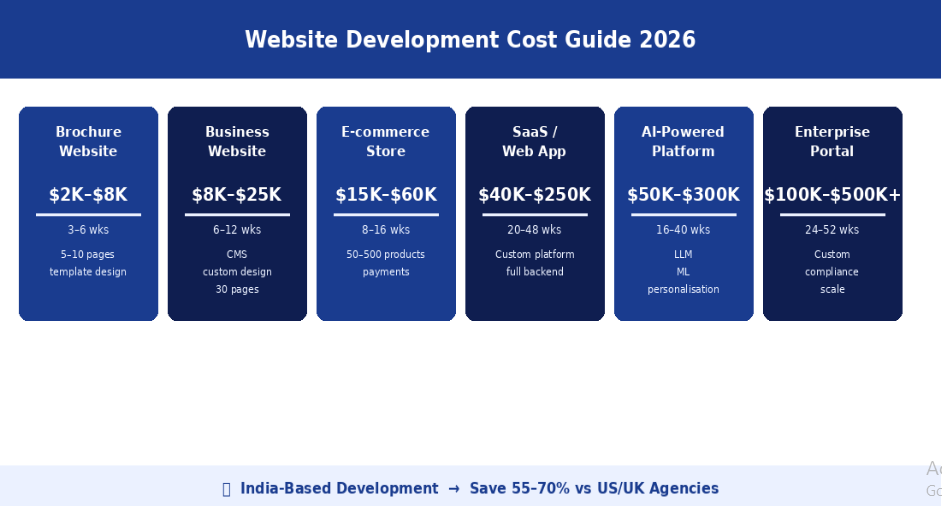
- – Brochure website (5–10 pages): $2,000–$8,000 | 3–6 weeks. Suitable for local businesses, consultants, and simple brand presences. Template-based, minimal custom design.
- – Business website with CMS (10–30 pages): $8,000–$25,000 | 6–12 weeks. Custom design, content management system, contact forms, basic SEO architecture.
- – E-commerce website (50–500 products): $15,000–$60,000 | 8–16 weeks. Product catalogue, payment gateway integration, inventory management, mobile-optimised checkout.
- – Large e-commerce platform (500+ products): $60,000–$200,000 | 16–32 weeks. Advanced filtering, multi-currency, loyalty programmes, ERP integration.
- – SaaS platform / web application: $40,000–$250,000 | 20–48 weeks. Custom backend, user authentication, dashboards, billing, API architecture.
- – AI-powered web platform: $50,000–$300,000 | 16–40 weeks. LLM integration, personalisation, recommendation engines, conversational interfaces.
- – Enterprise portal: $100,000–$500,000+ | 24–52 weeks. Custom platform, compliance, SSO, legacy system integration, enterprise SLAs.
The Outsourcing Factor: Why India-Based Development Makes Financial Sense
The most significant variable in website development cost is not the technology or even the complexity — it is geography. A senior full-stack developer in the United States charges $120–$200/hr. The equivalent talent at a reputable website development company in India charges $30–$60/hr. That is a 3–4x difference in the most expensive line item in any digital project.
For a mid-market web project that requires 1,000 hours of development time, that geography differential represents a saving of $70,000–$140,000. Reinvested into marketing, SEO, content, or AI development features, that saving can fundamentally change the ROI profile of your digital investment.
Sieg Partners is a top-rated website development company in India with 200+ completed projects across the US, UK, Australia, and UAE. Our clients consistently report equivalent or better quality compared to domestic agencies — at 55–70% lower cost.
The perception that offshore development means lower quality is a relic of early 2000s experience. In 2026, the leading website development companies in India have invested heavily in process rigour, communication infrastructure, and technical capability. Many have ISO certification, CMMI ratings, and portfolios that rival top US agencies.
Hidden Costs: What Your Budget Needs to Include Beyond Development
Development cost is just one part of the total investment. Executives who budget only for build often face uncomfortable surprises six months into operations. Here is what the full-picture budget needs to account for:
- – Hosting and infrastructure: $100–$5,000/month on AWS, Azure, or GCP depending on traffic and resilience requirements. High-traffic sites with redundancy can cost more.
- – Domain and SSL: $200–$1,000/year for domain registration, SSL certificates, and DNS management.
- – Ongoing maintenance: Budget 15–25% of original build cost annually for security patches, CMS updates, performance optimisation, and minor feature additions.
- – Third-party tool licences: CRM, analytics, A/B testing, live chat, marketing automation — these can add $500–$5,000/month depending on business size.
- – Content creation and SEO: Often the highest-ROI post-launch investment. Budget $200–$1000/month for content marketing and technical SEO if organic growth is a priority.
- – Payment gateway fees: Stripe and PayPal charge 1.5–3% per transaction. For e-commerce businesses, this is a meaningful ongoing cost that must be modelled into unit economics.
The total cost of website ownership over three years is typically 2.5–3.5x the initial build cost. Building this into your business case from the start leads to better decisions and fewer budget surprises.
An Executive Budgeting Framework: 5 Questions Before You Sign
Tie your budget to measurable KPIs — leads per month, conversion rate, revenue per visitor. A website development company that asks about KPIs before discussing price is a partner. One that skips straight to scope and cost is a vendor.
For SaaS platforms and marketplaces, budget for an ongoing development retainer: $3,000–$15,000/month with a quality website development company in India. For a static brand site, a one-time build may suffice with annual maintenance only.
High-traffic sites (100,000+ monthly visits) require CDN, caching layers, and load balancing investment from day one. Retrofitting performance architecture is expensive — build it in.
Chatbots, recommendation engines, and dynamic personalisation add significant cost but can deliver transformative results. An AI app development company like Sieg Partners can scope these features accurately so you can make an informed ROI decision.
Compressed timelines under 8 weeks typically cost 20–35% more due to the need for larger parallel teams. If your timeline is flexible, communicate that — it opens better delivery options and lower cost.

FAQs: Website Development Cost in 2026
A basic 10–15 page business website built by a professional website development company in India costs $6,000–$20,000. Template-based builds on Webflow or WordPress are cheaper at $2,000–$8,000, but offer less customisation and differentiation.
A mid-tier e-commerce site with 100–500 products costs $20,000–$80,000. Enterprise e-commerce with AI development features — recommendation engines, visual search, personalisation — can exceed $200,000.
Unequivocally yes, if you choose the right partner. Sieg Partners has delivered 200+ projects across four continents with a 96% client satisfaction rate and consistently receives direct comparisons from clients who have previously worked with US and UK agencies — at 55–70% lower cost.
Budget 15–25% of the original development cost annually for hosting, maintenance, security, and continuous improvement. This keeps your site fast, secure, and optimised.