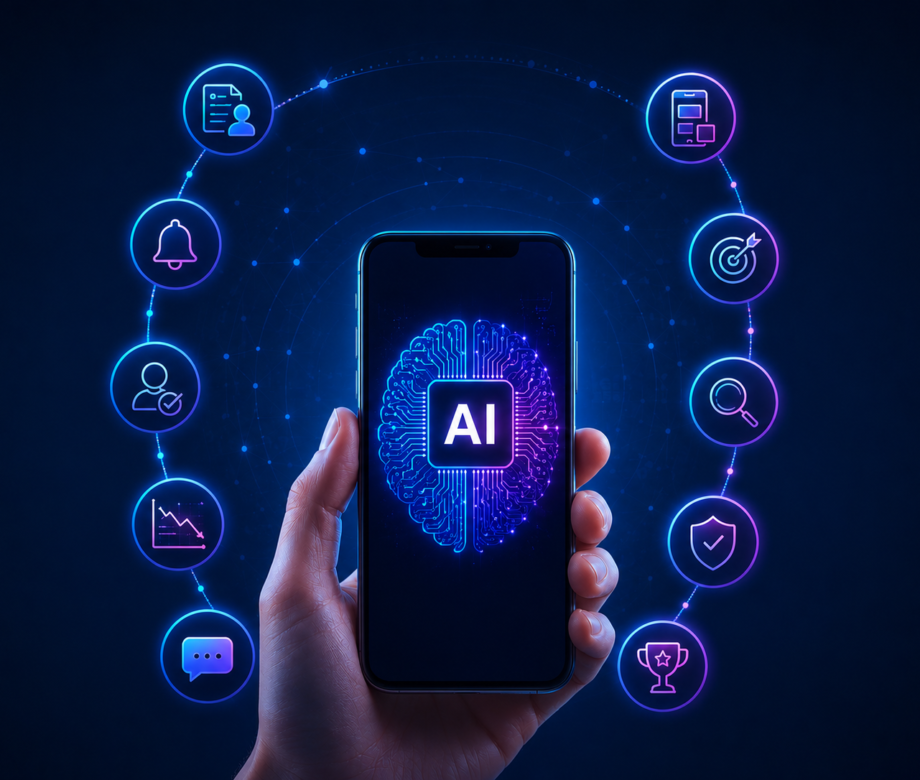


Artificial intelligence is no longer a feature you bolt onto a mobile app — it is the foundation on which every competitive application in 2026 is being built. At Sieg Partners, we help startups, SMEs, and enterprises design and ship AI-powered digital products. In this guide, we break down the 10 most impactful AI ideas for mobile app and software development in 2026 — with real statistics, practical use cases, and actionable insights your team can deploy today.
AI Feature Adoption in Mobile Apps by Sector — 2026
Table of Contents
Idea #1 · On-Device AI · Edge Computing
On-Device AI & Edge Intelligence
Running AI models directly on a smartphone — without relying on cloud servers — is one of the biggest shifts in 2026. Thanks to Apple’s Neural Engine, Google’s Tensor chips, and Qualcomm’s Snapdragon AI processors, mobile devices now pack serious inference power. Apps can run large language model (LLM) features, computer vision, and real-time translation entirely offline.
The benefits are substantial: zero latency, stronger user privacy (data never leaves the device), and lower cloud infrastructure costs. For enterprise apps managing sensitive data — healthcare, legal, fintech — on-device AI is not just a feature but a compliance requirement. At Sieg Partners, we leverage Apple Core ML, TensorFlow Lite, and MediaPipe to build on-device AI pipelines into iOS and Android apps.
$75B+
On-device AI market growth by 2030
40%
Reduction in cloud/API costs with edge AI
3x
Lower latency vs. cloud inference
Key Uses Cases
Offline Language Translation
Real-Time Object Detection
On-Device Fraud Scoring
Private Health Monitoring
Edge Speech Recognition
Idea #2 · AI Agents · Automation
Agentic AI & Autonomous App Workflows
The shift from chatbots to AI agents is the defining software story of 2026. Unlike a simple chatbot, an AI agent can autonomously plan, execute multiple steps, call external APIs, and complete complex tasks — all without human intervention at each step. Think of it as giving your app a junior employee who can book meetings, process invoices, respond to support tickets, and file reports without being asked twice.
Gartner predicts that 40% of all enterprise applications will feature task-specific AI agents by end of 2026 — up from less than 5% in 2025. That is an eightfold increase in a single year. Our team at Sieg Partners builds agentic workflows using LangGraph, AutoGen, and the OpenAI Assistants API, deeply integrated into mobile and web applications.
40%
Enterprise apps with AI agents by 2026 (Gartner)
8x
Increase from <5% in 2025
66%
Faster feature validation with agentic workflows
Key Uses Cases
Autonomous Customer Support
AI Invoice Processing
Smart Scheduling Apps
Agentic HR Automation
Multi-step Sales Workflows
Idea #3 · GenAI · Personalisation
Generative AI for Hyper-Personalisation
Personalisation has evolved far beyond “recommended for you” carousels. In 2026, generative AI allows apps to produce entirely customised user interfaces, dynamic content, personalised onboarding flows, and adaptive difficulty levels — all generated in real time based on that specific user’s behaviour, preferences, and history.
Apps that use AI personalisation achieve up to 50% higher retention rates than those without it. Streaming platforms see 35% higher retention. E-commerce apps see average order values 10–50% higher than mobile web sessions. Contact Sieg Partners to build hyper-personalised experiences for your users.
50%
Higher retention for AI-personalised apps
44%
Of mobile apps now use AI personalisation
35%
Higher retention on AI-driven streaming apps
Key Uses Cases
Dynamic UI Generation
Personalised Onboarding
AI Content Curation
Adaptive E-Learning
Smart Push Notifications
Idea #4 · Voice AI · Multimodal UX
AI-Powered Voice & Multimodal Interfaces
Voice interfaces have matured dramatically. In 2026, apps support full natural language conversations, context memory, and multimodal input — text, voice, image, and gesture in a single session. Users can photograph a product and ask a question about it, describe what they want and receive a working prototype, or navigate a complex dashboard entirely by speaking.
This trend is particularly powerful for accessibility, hands-free industrial applications, and emerging markets. NLP libraries like Whisper (OpenAI), ElevenLabs TTS, and Google’s Gemini Nano are enabling voice-first experiences that were impossible 18 months ago. AI-powered travel recommendations using voice increase in-app bookings by 32% (CMARIX 2026).
32%
Increase in bookings via AI voice recommendations
4.69B
Global smartphone users — voice-ready base
2026
NLP graduated from demo to production capability
Key Uses Cases
Voice Shopping Assistants
Hands-Free Field Apps
Accessibility Interfaces
Advanced Multimodal Search
AI Customer Service Bots
Idea #5 · Predictive Analytics · Data Intelligence
Predictive Analytics and Smart Recommendations
Every interaction a user has with your app is a data point. In 2026, the most competitive applications use this data to predict what users will need next, before they ask. Predictive analytics can forecast churn before a user leaves, identify the moment a customer is ready to upgrade, surface the exact product that converts, and flag users at health risk before symptoms appear.
For SaaS, predictive analytics can reduce churn by identifying at-risk accounts 30–90 days before cancellation. For e-commerce, smart recommendation engines consistently drive conversion lifts of 15–25%. Our engineers at Sieg Partners build custom predictive ML models using Python (XGBoost, PyTorch), BigQuery ML, and Firebase ML — scalable to millions of users from day one.
$210B
AI industry value in the app space (2026)
25%
Average conversion lift from smart recommendations
40%
Improved patient engagement via AI predictor
Key Uses Cases
Churn Prediction SaaS
Smart Product Recommendations
AI Demand Forecasting
Predictive Health Monitoring
Dynamic Pricing Engines
Idea #6 · AI Security · Fraud Detection
AI-Driven App Security & Fraud Detection
As apps become smarter, so do the threats targeting them. AI-powered security is a baseline expectation in 2026. Behavioural biometrics powered by ML can distinguish legitimate users from fraudsters based on how they type and swipe — not just what password they enter. Anomaly detection models flag suspicious transactions in milliseconds, and on-device AI can perform identity verification and liveness detection without sending biometric data to any server.
Mobile banking apps account for 65% of global financial transactions (CMARIX 2026) — making them the single largest fraud target. AI-based fraud detection demonstrates false-positive rates 60–80% lower than rule-based systems. For fintech, healthcare, and legaltech clients, Sieg Partners integrates AI-driven security layers including continuous authentication, transaction anomaly detection, and deepfake detection.
65%
Global financial transactions via mobile banking
80%
Lower false-positives with AI vs. rule-based fraud systems
48%
AI-generated code contains vulnerabilities without review
Key Uses Cases
Behavioural Biometrics
Real-Time Fraud Detection
Deepfake Identity Checks
AI Penetration Testing
Federated Learning Security
Idea #7 · Low-Code · No-Code · AI Development
Low-Code / No-Code AI App Builders
One of the most democratising shifts in 2026 is the rise of AI-powered low-code and no-code platforms. Tools like FlutterFlow, Bolt.new, and Cursor allow product managers and entrepreneurs to build production-grade mobile apps without writing a single line of code. By end of 2026, Gartner forecasts that 70–75% of new enterprise applications will be built using low-code or no-code platforms — up from less than 25% in 2020.
AI-assisted coding tools like GitHub Copilot and Cursor are making professional developers 40–50% more productive. The low-code market is projected to grow from $37.39 billion in 2025 to $264.40 billion by 2032 at a CAGR of 32.2%. At Sieg Partners, we blend low-code speed with custom development rigour — validate ideas in days, scale in weeks.
75%
New enterprise apps on low-code by 2026 (Gartner)
$264B
Low-code market projected by 2032
90%
Reduction in dev time with AI-assisted low-code
Key Uses Cases
Rapid MVP Development
Internal Enterprise Tools
Citizen Developer Platforms
AI-Assisted Code Generation
Automated Testing Pipelines
Idea #8 · AR · VR · Spatial AI
AI in AR/VR & Spatial Computing
Augmented reality and virtual reality have crossed the threshold from gimmick to genuine business tool — and AI is the catalyst. In 2026, AI powers the semantic understanding of physical spaces in AR apps, real-time scene reconstruction, AI-generated 3D environments for VR training, and AI avatars that respond intelligently in virtual meetings. Apple Vision Pro, Meta Quest 3, and Android XR are the platforms driving this wave.
AR-powered field service apps reduce repair times by up to 50% by overlaying step-by-step instructions on machinery. VR training simulations cut onboarding time for complex skills by 40%. Retail AR apps that let users visualise products in their home reduce returns by 25%. Our developers at Sieg Partners build AR/VR applications using Unity, ARKit, ARCore, and WebXR.
50%
Faster repairs with AI-assisted AR field service
25%
Fewer returns with retail AR visualisation
40%
Less onboarding time via AI VR training
Key Uses Cases
AR Field Service Apps
Virtual Try-On Retail
AI-Powered VR Training
Spatial Enterprise Dashboards
AI Avatar Virtual Meetings
Idea #9 · Cross-Platform · Flutter · React Native
AI-Enhanced Cross-Platform Development
In 2026, Flutter, React Native, and Kotlin Multiplatform are the go-to choices for teams that want one codebase serving iOS, Android, and web. When combined with AI-assisted development tools, cross-platform teams ship features 40–60% faster than pure native teams of equivalent size. AI co-pilots write boilerplate and business logic, AI design-to-code tools convert Figma directly into production-ready Flutter or React Native components, and AI performance profilers suggest platform-specific optimisations.
According to a 2025 cross-platform review, Flutter and React Native have each reached significant traction in enterprise job markets (Innowise, 2026). At Sieg Partners, we build cross-platform mobile apps that cut time-to-market by 35–50% compared to separate native builds — without compromising on user experience quality.
50%
Faster time-to-market with cross-platform + AI tooling
87%
Enterprise developers using cross-platform tools (Forrester)
$120K+
Software cost savings via AI cross-platform builds
Key Uses Cases
Flutter Enterprise Apps
AI-Powered Design-to-Code
Automated Cross-Platform Testing
React Native SaaS Products
Kotlin Crossplay B2B Apps
Idea #10 · HealthTech · AI Wellness
AI Health & Wellness Apps
The convergence of wearable sensors, on-device AI, and large language models is creating a new generation of health apps that function as always-on, personalised health companions. These apps monitor chronic conditions, detect early symptoms through continuous sensor data analysis, provide medication adherence reminders, support mental health through AI-powered CBT-style coaching, and connect patients with the right specialist — all from a smartphone or smartwatch.
Telemedicine app downloads are projected to grow 28% annually through 2026 (CMARIX). 55% of patients prefer booking appointments via mobile apps. AI-driven symptom checkers improve patient engagement by over 40%. Sieg Partners’ healthcare app development team builds HIPAA-compliant, AI-powered health apps from concept to App Store launch.
28%
Annual growth in telemedicine app downloads through 2026
55%
Patients prefer booking healthcare via mobile
40%
Improved patient engagement via AI checkers
Sieg Partners vs. Competitors — AI App Capabilities (2026)
How does Sieg Partners compare to other leading app development companies in delivering AI-native mobile products?
| Capability | Sieg Partners | Excellent Webworld | OpenXcell | Hyperlink InfoSystem | Hidden Brains | Spaceo Technologies |
|---|---|---|---|---|---|---|
| On-Device AI Integration | ✓ Full | ~ Partial | ~ Partial | ~ Partial | ~ Partial | ~ Partial |
| Agentic AI Workflows | ✓ Full | ✗ Limited | ~ Growing | ✗ Limited | ✗ Limited | ~ Growing |
| Generative AI Personalisation | ✓ Full | ~ Partial | ✓ Full | ~ Partial | ~ Partial | ~ Partial |
| AR/VR + Spatial AI | ✓ Full | ~ Partial | ✓ Full | ✓ Full | ~ Partial | ~ Partial |
| Healthcare AI Compliance | ✓ HIPAA + GDPR | ~ GDPR only | ✓ Full | ~ Partial | ~ GDPR only | ~ Partial |
| Cross-Platform (Flutter + RN) | ✓ Full | ✓ Full | ✓ Full | ✓ Full | ✓ Full | ✓ Full |
| AI Strategy Consulting | ✓ Included | ~ Add-on | ~ Add-on | ✗ Not offered | ✗ Not offered | ~ Add-on |
AI App Development Roadmap — Sieg Partners Process

AI Discovery & Strategy
Use case mapping, data audit, ROI modelling

UX Design + Prototype
AI-assisted Figma, clickable prototype validation

AI Model + App Build
Sprint-based, AI copilot-assisted development

AI QA + Testing
Automated testing, model accuracy benchmarks

Launch + Optimise
App Store, AI model retraining & monitoring
Ready to Build Your AI-Powered App in 2026?
Sieg Partners has delivered 150+ mobile and software products across fintech, healthcare, e-commerce, and enterprise. Let’s architect your next-generation AI application together.
Frequently Asked Questions
The cost varies significantly based on complexity, AI feature depth, platform (iOS, Android, or both), and integration requirements. A basic app with AI personalisation starts around $25,000–$50,000. A full-featured app with agentic AI workflows, on-device ML models, and real-time analytics can range from $80,000–$250,000+. Contact Sieg Partners for a detailed project estimate.
With AI-assisted development and agile sprints, a production-ready MVP can typically be delivered in 10–14 weeks. More complex applications with custom AI models, compliance requirements (HIPAA, GDPR), or deep third-party integrations typically take 16–28 weeks. Our development process at Sieg Partners is optimised for speed without compromising on quality or security.
The most in-demand AI technologies include on-device LLMs (Core ML, TensorFlow Lite), agentic AI frameworks (LangGraph, AutoGen), generative AI APIs (OpenAI, Anthropic, Google Gemini), multimodal interfaces (Whisper, ElevenLabs), AI-assisted development tools (GitHub Copilot, Cursor), and predictive analytics stacks (BigQuery ML, XGBoost).
Look for a company with a demonstrable portfolio in AI-native apps, transparent AI model development practices, compliance expertise for your sector, and a clear process for iterative post-launch improvement. Sieg Partners offers a free AI readiness assessment to identify which capabilities will deliver the highest ROI for your product.
Fintech and banking lead adoption (88%), followed by healthcare and telemedicine (82%), e-commerce and retail (79%), and EdTech (74%). However, every industry with a mobile touchpoint — logistics, real estate, insurance, legal, field services — is seeing significant AI app investment in 2026.
AI app development is accessible to startups in 2026 in ways it simply wasn’t in 2022–2023. The rise of AI APIs, low-code platforms, and open-source models means a well-funded startup can ship a sophisticated AI-powered product with a lean team. Sieg Partners works with startups from seed stage through Series B and beyond.
Conclusion: The AI-Native App Era Has Arrived
2026 is not a year to “explore” AI for your mobile app — it is a year to execute. With 70% of mobile apps already incorporating AI features, the baseline has shifted. The question is no longer whether your app should be AI-powered, but how deep and how intelligently you integrate AI across your product experience.
The ten ideas covered in this guide — from on-device edge AI to agentic workflows, generative personalisation to spatial computing — represent the highest-ROI investment areas for mobile and software development this year. Each has documented case studies, measurable business outcomes, and mature tooling that makes implementation achievable at any scale.
At Sieg Partners, we combine deep AI engineering expertise with product strategy to help you identify the right AI capabilities for your business, build them with precision, and iterate rapidly post-launch. Whether you are starting from scratch or adding AI to an existing product, we are ready to be your technology partner in 2026 and beyond.

About Author
Mehran Baloch
Mehran Baloch is the visionary CEO of Sieg Partners, a top mobile app and software development company in Ahmedabad, India. With expertise in AI, IoT, Blockchain, and custom software solutions, he has led Sieg Partners to become a trusted name in IT consulting, mobile app development, and digital transformation.
As a tech enthusiast and problem-solver, Mehran stays ahead of the latest technology trends to deliver innovative IT solutions for businesses worldwide. His leadership ensures clients get cutting-edge mobile apps, enterprise software, and AI-driven platforms.
With a strong focus on emerging technologies and business growth, Mehran Baloch continues to drive success for startups, enterprises, and global brands looking to scale with technology.
🔹 Expertise: Mobile App Development, AI, IoT, Blockchain, Software Development, IT Consulting
🔹 Company: Sieg Partners – Leading IT Solutions Provider
For collaborations and IT solutions, connect with Mehran Baloch -CEO : Sieg Partners today!